BNS Founder interviewed by Telecoms Asia

“To Peer or Not to Peer”

Last month, the Philippine Senate conducted a hearing to investigate the reason behind the country’s slow and expensive internet connection. What prompted the probe was an infographic posted by ASEAN DNA on Facebook showing the Philippines in the bottom three Southeast Asian countries with the slowest average internet speed, based on an Ookla speed test. That post has since gone viral, especially among disgruntled Filipino netizens.

Local IP peering was one of the possible solutions mentioned at the hearing by no less than the regulator, the National Telecommunications Commission (NTC).  Soon after, a number of articles on IP peering began making the rounds on social media. There was even a change.org petition urging PLDT, the incumbent telco and largest ISP, to do local IP peering.

Now what does this tell us? The demand for better internet service has reached such a critical point that even the ordinary customer is becoming interested in something as technical as IP peering.

How and why is peering important to getting faster and more affordable internet connection?

To help answer this, I had a chat with Wilson Chua, managing director and co-founder at Bitstop Network Services, Inc. Starting out in computer distribution, Bitstop next ventured into operating a franchise of paging service EasyCall and promoting Mozcom in the province of Pangasinan before branching out to call centers and data-center operations via BNShosting.net. Bitstop was the first local ISP to peer via the Philippine Open Internet Exchange (PHOpenIX), the only publicly funded, neutral, and non-profit internet exchange point in the country. Below, Chua responds to my questions on peering and how it is benefiting Philippine internet.

TA: Can you explain what local IP peering is and how it benefits an ISP like Bitstop?

Local peering happens when two or more network operators decide to “meet” each other at a common point (the internet exchange or IX). When peering, an operator agrees to let others use the interconnection link to pass traffic from its own network to another operator’s network, and vice versa. By doing so, both parties benefit from a reduction of bandwidth by using the cheaper direct links instead of the costly international circuits. Operators who peer also agree to not charge the other party for the traffic, so neither party pays for the exchanged traffic.

Local peering has several benefits:

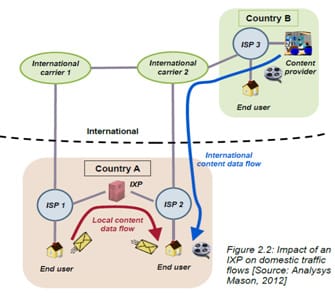
  1. Faster access times. Our hosted clients benefit from having their sites connected directly to the local internet community in the Philippines via the shortest distance possible. This improved network performance is one of the main reasons for connecting to the IXP. In an illustration (below) from a reportby Analysys Mason and Internet Society, you can see that users of ISP1 can get to ISP2 via direct peering links (red line with arrow). Without this peering, ISP1 users will have to go out of the country, use the expensive international links, pass via another carrier, and then on to another ISP3, before getting back to the country to reach ISP2. The same process happens vice versa. This is inefficient and slow, and can burden international bandwidth resources.
isp-image

  1. Resiliency. As the Philippines is located in the Ring of Fire and the Typhoon belt, we see that most carriers’ links are affected by earthquakes and storms from time to time. When some of these links go down, the IX can provide an alternative path for the traffic of various operators to pass to get to each other’s local network. Going back to the illustration, suppose ISP1’s link to International Carrier 1 (purple line) goes down (like in the case of the Taiwan earthquake). Without the peered links (red line), ISP1 users will not be able to talk to ISP2 users.
  2. Community relationships. Since the exchange puts system admins in regular contact with each other, we find it easier to form communities of interest and help each other out with common issues like security (e.g., hacking and cyber-attacks).
  3. Efficient marketplace for bandwidth. Some of the IXPs have evolved into a universal market place to buy bandwidth from other peered partners. Peered partners can buy from other peers with excess bandwidth capacity, for the former to fill up spikes in their traffic. This effectively provides a market-based mechanism for internet pricing—one that is not subject to “lockdowns” by current providers.        

TA: When did you start peering? How did you find out about the PHOpenIX?

I was influenced by APNIC and Dr. William Norton, both of whom have been highlighting the power and benefits of peering exchanges since the 1990s. So from the early days, we were peered with PLDT’s PHIX. However, they price their local loop (last mile) so high such that all the other peered partners could only put in small links. This wasn’t enough to sustain the local community. Imagine a peering point with 2mbps links only. Later on, the Manila Internet eXchange (MIX) and BayanTel’s NIGX offered us a connection. We connected to these as well, but since they were telcos, I couldn’t see other telcos and ISPs connecting to these exchanges.

When I heard that the government was developing a neutral peering point, the PHOpenIX, I immediately signed up from day one. Since then, we have grown our link from a measly 512kbps to 50mbps today. 

TA: What considerations did you take before deciding to peer via the PHOpenIX?

It had to be sustainable and had to have the potential of getting a critical mass of operators using it. Peering has what we call Network Efforts. As more networks are connected, the value of the peering point increases. As the Metcalf Law states, “The value of the telecommunications network is proportional to the square of the number of connected users of the system.” I think the PHOpenIX is about to reach that critical mass of users with news of more operators coming in and peering.

Source: http://www.telecomasia.net/blog/content/peer-or-not-peer-conversation-bitstopph

“gDayx Dagupan” Seminar in Ricafort Tee Pavillion

BNS is a co organizing the seminar gDayx Dagupan in Ricafort Tee Pavillion  on April 30, 2014 that aims to provide the venue to educate the ICT Stakeholders and enthusiasts regarding the prospects of entrepreneurship in ICT and the creation of a startup business.

The Startup workshops will be a one-day event and will be targeting participants from the different stakeholders of the startup and ICT industries in the regions. This will include students who are in fields of computer studies and business management courses, professors and school administrators and representatives from the private business partners and local government units.

The main goal of the Program is to have 50 local startups based in the Philippines with a company valuation of 10 Million Pesos or more by the end of 2016.

And here are the program activities on that day:

Time

Activities


8:00 to 9:00 AM Registration of Participants
9:01 to 9:30 AM Opening Ceremonies (Philippine National Anthem and Invocation)Welcome Remarks by the Host LGU / ICT Council
9:31 to 9:50 AM Opening Message by DOST-ICT Office
9:51 to 10:10 AM Startup Innovations and TrendsThe discussion will include an overview of the local and global landscape of the Startup community. The speaker will also discuss the relevance of this initiative and the major players that contribute to the developments of the industry in the country. This topic will also include:

  • What are the global trends in startup and business innovation? What ideas are booming? And why?
  • What are the local innovations that we should look out for?
  • What major areas of business or general concern can startups go into? Are there any untapped markets or innovation areas that may be covered?
  • Are there any areas that should be avoided or are have less success rate especially in new startup companies?
  • Are there similar factors and/or traits you have seen that may bring about success or failure in startups
10:11 to 11:15 AM Startup 101Startup 101 will tackle basic concepts and methods discussing the ff:

  • What is a startup? What are examples of startup (ICT) companies? Can i do it alone?
  • What do we need to get started?
  • How does technology come into play in building a startup?
  • If I have a business/ tech idea? What are the general steps in building my startup company?
  • Who can I contact in my early stages of idea development? Who can help?
  • What activities can I participate in to get my ideas going?
  • What does it take to be a successful startup founder?
  • What business/ tech ideas are making it big in the industry?
11:16 to 12:15 PM Startup TalkStartup talk speakers will share their experiences in creating their own startups. Specifically:

  • How did you get into building your own startup?
  • What is your startup about and how did you come up with the idea? Why is it relevant? Marketable? Worth pursuing?
  •  How did you develop your company? What are the difficulties you’ve encountered and how did you address them?
  • What are the benefits of building your own startups? What are your recent success milestones?
  • What do you think are the qualities that make a successful startup founder? To make a successful team/ company?
12:16 to 1:30 PM Lunch
1:31 to 2:30 PM Pitching Basics and Fire PitchesThe discussion will cover pitching tips and tricks for beginners who have not experienced joining startup competitions. The talk will provide tips on what areas to consider when developing tech ideas and pitches and how to effectively convey their ideas through short-time pitches or for networking purposes. If Possible a select number of participants will be given the chance to do mock pitching to get and actual feel of the experience.
2:31 to 3:30 PM Startup Ecosystem and SupportSpeakers for this topic will involve representatives from national or local startup organizations and communities who contribute greatly in strengthening and providing appropriate support for startups. Their talk will include:

  • Based on their organization’s activities and experiences, a description of the Philippine startup community today
  • Common issues that startups are facing – How does your organization address such issues?
  • Observed qualities that individuals may possess to survive the process of building and running a startup
  • Organization’s activities and programs – what does the organization do to support startups and potential technopreneurs?
3:31 to 4:00PM Intellectual Property Concepts / Startup Support from GovernmentStartups should be proactive in developing and protecting their intellectual property. Intellectual property is a business asset and has commercial value.  This will also protect the startup’s competitive advantage and also use this as a marketing edge. Speakers should be able to present:

  • Why should A Startup take steps to protect Intellectual Property?
  • How to apply, what are the necessary requirements?
  • What are the benefits/advantages?
4:01 to 4:15 Break
4:16 to 5:45 PM Open Forum/Panel Discussion and Break Out Sessions
5:46 to 6:00 PM Closing Remarks from LGU / ICT Council

For further information and coordination, please contact Karla Legaspi of the ICT Industry Development Team at (02) 920-0101 loc. 1101 or email at karla.legaspi@icto.dost.gov.ph.

BNS team joined the Iglesia ni Cristo – WORLD WIDE WALK (for Haiyan/Yolanda victims) on February 15, 2014

For there will never cease to be poor in the land. Therefore I command you, ‘You shall open wide your hand to your brother, to the needy and to the poor, in your land.’ (Deuteronomy 15:11)

In all things I have shown you that by working hard in this way we must help the weak and remember the words of the Lord Jesus, how he himself said, ‘It is more blessed to give than to receive.’ (Acts 20:35)


Why You Should Learn to Run a Server Before You Learn to Code

To the disappointment of everyone who wants to learn to code so they can get rich or powerful, developer Dave Winer tells us that’s probably not going to happen. He lists good reasons why you might want to learn to code, but recommends you learn to run a server first.

Learning to code is good if you have a calling, if you feel it’s what you must do to express yourself. If you have ideas that you can implement in code that no one else is doing. Or if you just love the puzzles that programming is constantly presenting you with. You have to have a certain amount of self-hatred to love programming, btw, because it’s a grind. And to do it well you have to have a lot of all of these things.

You might think that by learning to code you get to be the Man Behind the Curtain, the all-powerful person who makes the digital world work. But that’s not what coding is about. If you want power, and I’ve said this many times — rather than learn to code — first learn to run a server. That’s real power. And it’s far easier than programming.

Plus, running a server, Winer says is a gateway into programming.

source link for this nice article: http://lifehacker.com/why-you-should-learn-to-run-a-server-before-you-learn-t-1497178889?utm_campaign=socialflow_lifehacker_facebook&utm_source=lifehacker_facebook&utm_medium=socialflow

Government Website Template (GWT) Accreditation Exam

A Government Website Template (GWT) accreditation exam for web developers and trainers will be held on the following schedules:

-November 26 & 28, 2PM at HCDG Conference Room, ICT Office Bldg., C.P. Garcia Avenue, Diliman, Quezon City.

-December 3 & 6, 2PM at ASTI Computer Laboratory, ASTI Bldg.,C.P. Garcia Avenue, Technology Park Complex, Dilman, Quezon City

The accreditation exam aims to build a pool of web developers, which will assist the development of GWT in WordPress, Drupal and Joomla, and trainers that will train the web developers of regional agencies, LGUs and SUCs.

Interested individuals may register here: http://bit.ly/HPdryu

For more details and inquiries, please contact Phoebe Sumiran at phoebe.sumiran@icto.gov.ph

Digital Influencer Boot Camp in Dagupan

BNS is co organizing the Digital Influencer Boot Camp in Dagupan by Ms Janette Toral on Sept 9, 2013.

Details here:
http://digitalfilipino.com/ai1ec_event/digital-influencer-boot-camp-dagupan/

Register now to reserve your seat.

Early Bird Registration Fee : Php 1, 000.00 per head
Contact: Ms. Carol N. Sanchez and Ms. Mylene M. Saluta
075-5158750 to 54 / 6533247 / 6534388
09175080964 / 09175081163 / 09399396698 /
Email: team@bnshosting.net
Participants are expected to bring their own laptop for the event.

Preventing Webform Based Spam


Have you ever wondered why your email server is sending you a lot of ‘bounced’ email reports? This might be due to a Hacker attack called “spam injection” on web forms that are poorly written.

First they use “zombies” (PC’s that they have been able to take over) to scan the Internet for web pages containing forms.

Then they try to insert some special code into the fields of your form that will trick your server into sending the form email to a different address, an address that your server is fooled into thinking is specified in a “bcc” field.

To begin they will test your server to see if they can re-route the form to send email to a throwaway email address (usually an AOL address). Once they are successful, they start sending spam emails via YOUR webform. And when those emails bounce, they bounce back to YOUR email server!

Several tips on how to prevent webform spams:

1. Use Captchas.
(http://webdesign.about.com/od/forms/qt/protect-forms-from-spammers.htm)
A CAPTCHA is a visual image (usually of a series of characters) that are written in a strange font and are difficult to read. They are supposed to be impossible for a computer to read, but a human can read them. Then your readers read the text, fill in the correct letters, and their form is submitted.

2. Use CSS and Javascript to fool spam bots
(http://webdesign.about.com/od/forms/qt/protect-forms-from-spammers.htm)
Many of the spam bots don’t read JavaScript, or they don’t read it well, so you can encrypt an entire form in JavaScript and block the spam bots from seeing it. Your readers will only have a problem if they don’t have JavaScript turned on.

One way that I like to fool spammers is to add CSS to forms to hide certain fields. When the spam bot comes in and reads the HTML, their bot sees that form field and fills it in. Then when I get the results any entries that have that field are automatically deleted. To do this use the display: none; property on the field. Web browsers will leave that form field completely off the page, but spam bots will see it in the HTML and fill it in.

3. Environment Checks
(http://askmichel.icoder.com/2007/01/28/how-to-protect-a-contact-form-from-form-spam-bots/)
Every browser sends a HTTP_USER_AGENT value to a server. So a missing HTTP_USER_AGENT value almost always indicates a spammer bot.
The most of browsers (all modern browsers) send a HTTP_REFERER value, which would contain the submitted form URL. Whereas clever bots send this value, a missing HTTP_REFERER value could mean a bot submitting.
Note. There are several firewall and “security” products which block HTTP_REFERER by default. So, none of these people could send a message if you block posting without HTTP_REFERER.
You can use this PHP-code to do the Environment Checks:


4. Extra Form Fields
(http://askmichel.icoder.com/2007/01/28/how-to-protect-a-contact-form-from-form-spam-bots/)
Yet another way to avoid of spamming by bots is Extra Form-fields where people have to answer an intellectual question like “which day comes after tuesday?” or “spell the number 7 in lowercase letters”. You can take a look at such form at the blog of Kim K. Jonsson.

In order to do not bother people with extra questions, you can invert the Extra Form-fields tactics. Place a blind field with an attractive name into your form. Only bots could detect this fields and fill it out. For example:

Your Name:
Your Email:

Only bots would fill the “email” field, real people will enter emails into the “x” field.

Anders Brownworth suggests to make the Submit button as image and require realistic mouse coordinates with the form posting. Your form processor should then approve the coordinates with etalon. You can take a look at this way realized in the Anders blog.

Anvil Live Streaming

Visit live streaming http://live.anvil.ph/

The 48th Anvil Awards, the Anvil of many “firsts”

by Lou de Guzman, APR

On March 6, 2013, the 48th Anvil Awards will earn its place in the industry as the Anvil of many “firsts” as it honors the best in PR practice. An overwhelming support from industry players turned in almost 400 entries, breaking past records of the Anvil Awards.

For the first time this year, digital campaigns are recognized as a distinct category under PR Programs – on a sustained basis. Likewise, multimedia and digital tools are grouped in a single Multimedia category under PR Tools. The criteria for the Anvil’s highest honor, the Hall of Fame Award, are also now defined and established.

Another achievement of the 48th  Anvil Awards is having Vishnu Mohan, CEO of Havas Media, Asia Pacific, as the Chairman of the Board of Jurors, bringing in his expertise and experience in traditional and digital media, as well as sharing the benefits of a regional and perhaps global perspective in the judging process.

This year, there are 33 Jurors, and the composition of the Board of Jurors has expanded to include IT specialists, members of academe, social media experts, specifically for the newly recognized categories of digital campaigns, multimedia, and digital tools.

For the first time ever, the 48th Anvil Awards will go digital, live streaming through live.anvil.ph with delayed telecast at Kapuso GMA News TV.  The winners and guests can join the online conversations via Twitter #anvilawards.  The event is slated at 6pm at the Makati Shangrila Hotel.

Award sponsors include Globe Telecom, Pepsi Cola, PCSO, Certified Digital Marketer Program, Photo Live, eRadioPortal.com.  Media partners include GMA News TV, ABS CBN, Philippine Daily Inquirer, Manila Bulletin, Philippine Star, Business Mirror, and Business World.

The Anvil Awards is an annual recognition program of the Public Relations Society of the Philippines (PRSP) to recognize excellence in PR Programs and Tools.